Thomas Edison: The Inventor Who Made Electric Lighting Practical for the Modern World
Published by John Oruebi Eniekpo in Tech Tutorials & Mentorship
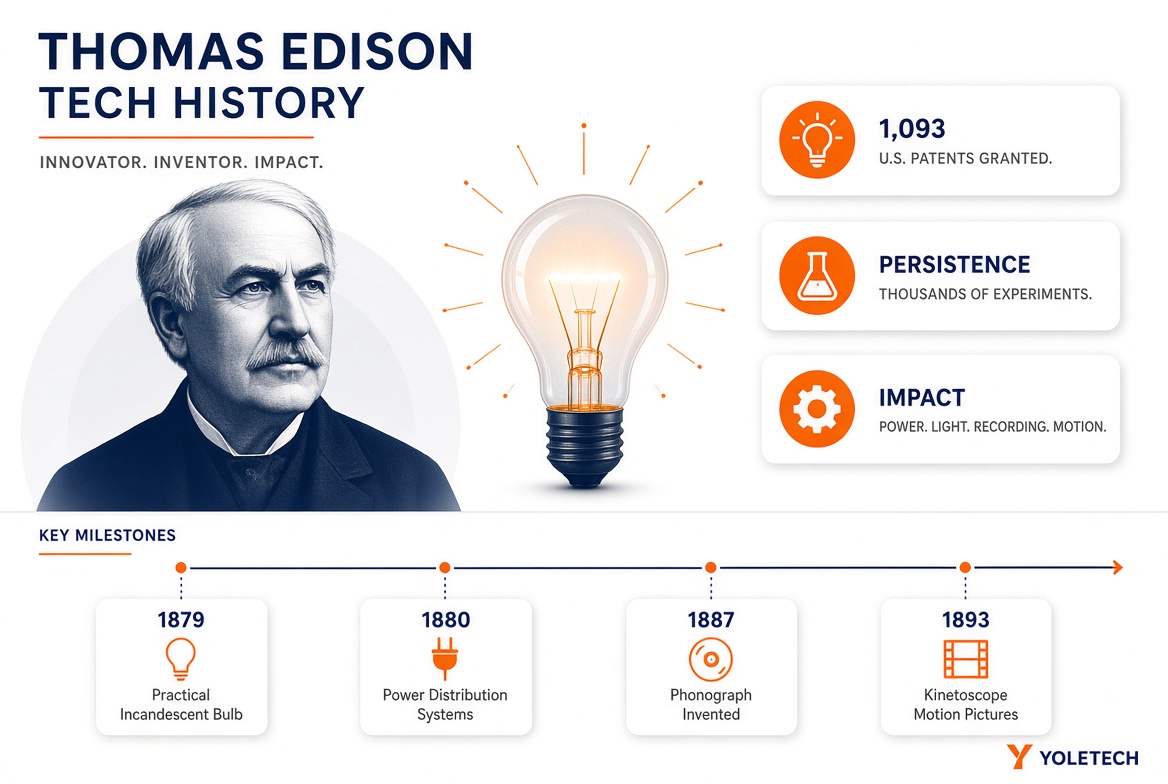
Thomas Edison developed a commercially practical incandescent lighting system in 1879, helping bring electric lighting into homes, businesses, and cities.
**Who Was Thomas Edison?**
Thomas Alva Edison (1847–1931) was an American inventor and businessman known for developing several influential technologies, including the phonograph, motion-picture equipment, and a practical incandescent electric lighting system.
Although Edison is popularly credited with inventing the light bulb, electric lighting had been studied by many inventors before him. His major contribution was developing a reliable, longer-lasting incandescent lamp and the electrical infrastructure needed to make electric lighting commercially useful.
**When and Where Did He Develop It?**
Edison began intensive work on practical electric lighting in 1878 at his Menlo Park laboratory in New Jersey, United States.
On October 22–23, 1879, his research team successfully tested a carbonized cotton-thread filament that burned for approximately 14.5 hours.
On December 31, 1879, Edison publicly demonstrated his electric lighting system at Menlo Park.
He received U.S. Patent No. 223,898 on January 27, 1880.
**How Was the Light Bulb Developed?**
Edison and his research team experimented with thousands of materials to find a suitable filament.
Their work focused on three important requirements:
1. **Filament:** Finding a material that could become hot enough to produce light without burning out quickly. 2. **Vacuum:** Removing air from the glass bulb to reduce filament deterioration. 3. **Electrical efficiency:** Developing a high-resistance filament that could operate effectively within a practical electrical distribution system.